
Fond du Lac Directory Holdings
The Fond du Lac city directory record begins with scattered early titles, develops into a near-biennial printed run, and later gains an address-first criss-cross tool. No local official page prints one complete shelf list. Verify a desired edition in the Seefeld Local History Room catalog or Winnefox title record before planning a visit.
| Collection | Years | Where held | Access |
|---|---|---|---|
| Brigham and Beeson directories | 1857-58; 1865-66 | UW/Recollection leads and local collections | Digital record or verified shelf copy |
| Gazetteer and early city books | 1868; 1870; 1872-73; 1875-76 | Library and established catalog records | Verify title and scan availability |
| Regular printed run | 1903-1921, mostly odd years | Seefeld and catalog inventory | Local shelf or title-specific scan |
| Interwar and war-era run | 1924-1948, mostly even years | Seefeld and archive records | Shelf and collection-dependent digital access |
| Postwar directories | 1951, 1953-55, 1957, 1959, 1960 | Seefeld / ResCarta title records | Confirm exact edition |
| Criss-cross directory | 1978 | Library of Congress guide and local lead | Address-to-occupant research |
Publication gaps are normal. The research did not establish a final printed year, and no war-year suspension should be assumed. A city directory year is the date of that edition, not a promise that every resident responded or remained at the address for the full year.
First Fond du Lac City Directories
Brigham and Co.'s 1857-58 City Directory and Business Advertiser is the earliest identified lead. Beeson’s Printing Office issued the 1865-66 directory, now represented by a University of Wisconsin digital record and scan. An 1868 county gazetteer broadens the geography, while a known 1870 city title and Hollands' 1870s issues help fill the next years.
These books grew with a city chartered in 1852 and situated at the foot of Lake Winnebago. Early pages combine residents, firms, ads, public facts, and street guidance. That mix is useful. A trade or shop can separate two people who share initials, and an advertisement may describe a location by a landmark rather than a number.
Recollection Wisconsin notes that the 1876 Centennial-era material could use English and German. Preserve original spelling and try translated trade words, business names, initials, and nearby streets. Modern spelling may hide the printed match.
Search Fond du Lac Directory Scans
Winnefox ResCarta is the main online collection doorway. Choose Fond du Lac County and City Directories before entering a word or date. The portal also holds Fond du Lac history books, maps and atlases, postcards, anniversaries, North Fond du Lac yearbooks, Wisconsin census records, newspapers, and pioneer-church material. Those companion sets can explain a directory entry without turning the search into an unrelated name hunt.
| Portal control | Input | Use in a city-directory search |
|---|---|---|
| Collection | Checkbox list | Select Fond du Lac County and City Directories, then add only useful companion sets. |
| Simple Search | Optional text | Try surname, initials, trade, business, or street. |
| Date From / To | Date or text | Narrows the selected collection by era. |
| Browse Collections | Mode | Reveals grouped local holdings. |
| Browse Titles | Mode | Checks editions when text recognition fails. |
The landing form does not state every title's year range. Read the scan metadata before citing an edition. Optical text search can miss ornate type, worn pages, initials, or German forms, so browse the alphabetic pages after a failed keyword search.
The Fond du Lac Public Library local-history page also points to thirteen digitized People and Places books. Those works supply context, but an entry should still be tied to its directory title and page.
Open the Winnefox ResCarta search shown below to select the directory collection.
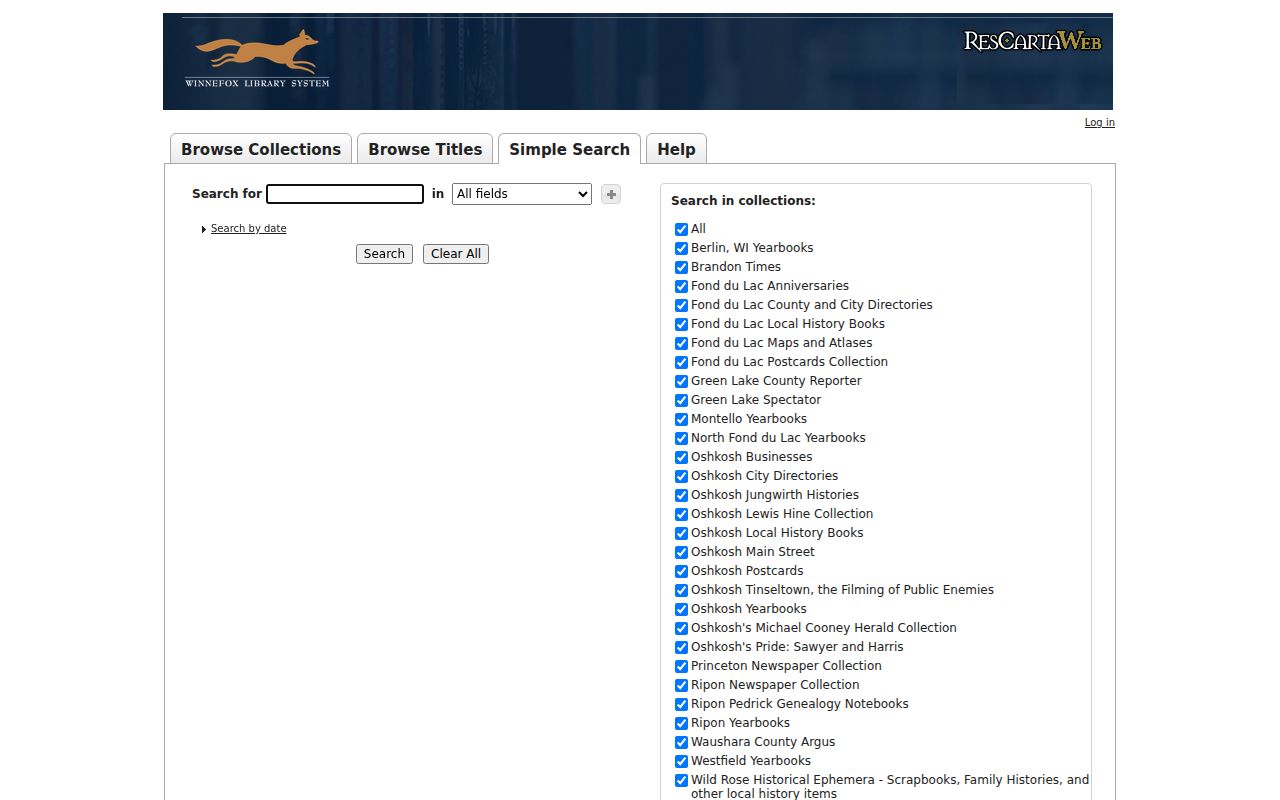
The archive screen shows why selecting a collection and checking its displayed date are both part of a sound citation.
Decode a Fond du Lac Directory
An alphabetic entry often compresses a life into one line. Read the volume's abbreviation key first. The 1865-66 scan and collection guidance support a pattern of name, trade, residence or boarding mark, and address. Some editions add a spouse or widow notation, an employer or business address, and separate business and street guides. Do not assume that every edition marks ownership.
| Name | Surname, given name, and often initials in the printer's original order. |
|---|---|
| Trade or occupation | A role that can distinguish names and lead to an advertisement. |
| Home address | House number and street, sometimes with “h” for home. |
| Boarding mark | “b” may mean boards; confirm it in that edition's key. |
| Family notation | A spouse or widow mark may connect members of a household. |
| Business place | May differ from the home and may be described by a landmark. |
- Criss-cross directory
- An address-first directory arranged by street and house number.
- Householder index
- A list keyed to a household head or address, depending on the publisher.
- Abbreviation key
- The edition's own legend for short forms such as home, boards, trade, and status.
A printed occupant can be a renter or boarder absent from a property roll. It remains a historical clue. Cite the edition, page, exact text, and any reading uncertainty.
Fond du Lac Directory Library Shelf
The Seefeld Local History Room sits on the second floor of the downtown Main Library and reports more than 2,600 local and regional items. Its holdings include city and county directories, newspapers and indexes, plats, cemetery records, family histories, and local books. This scale makes the room an active access channel, not a footnote after online searching.
Reference questions may go to 920-322-3930 or reference@fdlpl.org. The library offers appointments of up to one hour with a Local History Librarian. Its page and footer list different phone contacts, so confirm the right desk before visiting 32 Sheboygan Street. Library-only genealogy subscriptions may also supply census and family material unavailable from home.
Preview the public library's local-history page shown below before asking for shelf help.
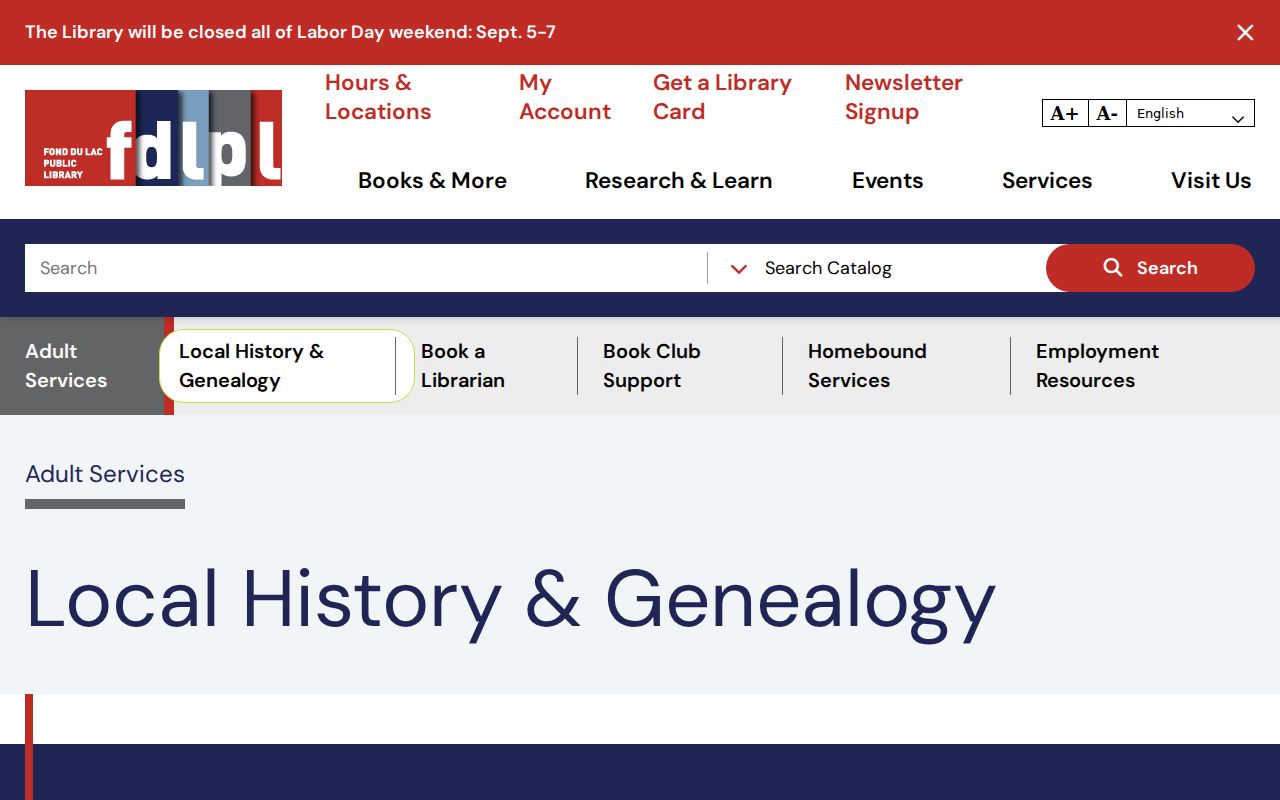
The local-history page ties the printed directory shelf to staff help, maps, newspapers, and other dated evidence.
Note: Ask staff to verify the title page and abbreviation key whenever a catalog year comes from a secondary inventory.
Fond du Lac Historical Indexes
The Fond du Lac County Historical Society library works by appointment and accepts written research questions. Contact info@fdlhistory.org or 920-922-1166, or write to PO Box 1284, Fond du Lac, WI 54936. Research and copies carry fees supplied by the society. A focused request should give the names, date range, known address, directory year, and desired copy or citation.
Its indexes are unusually specific. Court material covers 1845-1940, marriage applications 1899-1939, grocers by name and street 1940-1969, restaurants 1940-1969, and the Hill Obituary Scrapbook 1924-1926. It also lists WWI news clippings, 1910 plat-book photographs, probate, railroad files from the 1920s and 1930s, genealogies, and original documents. A shop name found in a Fond du Lac city directory can therefore lead to a street index and an obituary clue.
Read the Historical Society library page shown below for its appointment and inquiry route.

The capture reinforces that staff research and named local indexes fill gaps left by incomplete digital runs.
Fond du Lac Directory Timeline
Directory dates sit within a longer local record history. They should not be stretched to claim a countywide loss or an unverified publication cutoff.
| Year | Directory or local record milestone |
|---|---|
| 1857-58 | Earliest identified Brigham city-directory lead. |
| 1865-66 | Beeson directory and business advertiser now has a UW digital scan. |
| 1903-1960 | Regular, though not complete, printed city-directory run represented in local holdings. |
| 1978 | Criss-cross directory supplies a later address-first bridge. |
| Present access | Seefeld shelves, ResCarta, UW/Recollection, and staff-led historical indexes share the work. |
The circa-1881 county courthouse at about 180 South Main was demolished in 1981, but no official courthouse-fire or countywide records-loss event was found. Keep that history separate from the verified St. Paul Cathedral fire.
A Fond du Lac Date Anchor
St. Paul Cathedral gives a vivid test of directory and map evidence. Its first building was completed in 1852, burned on January 25, 1884, and began rebuilding on October 5 of that year. The first service in the rebuilt cathedral was held April 10, 1887. That event does not show that county records burned. It dates a specific site and change.
Compare an 1884 directory or street clue with the Wisconsin Historical Society's 1884 Sanborn sheet, then check later 1898 and 1902 maps and the next available directory. A household or business nearby may use the cathedral as a landmark. The building footprint and use come from the map, while a city directory supplies the printed person or firm. Keeping those roles apart makes the story reliable.
Trace Fond du Lac Families
City directories are strongest between federal census years. They can narrow when a person arrived, moved, changed a trade, married, or vanished from the printed roll. Census schedules are decennial, and federal law keeps them closed for 72 years. As of 2026, the 1950 census is public while later schedules are not. Directory and census dates will rarely align exactly.
- Choose a year when the address or surname is known. Search the street guide first if the place is more certain than the name.
- Copy the line exactly, including initials, spouse or widow mark, trade, home or boarding sign, and address abbreviation.
- Check the next available Fond du Lac city directory and nearest open census. Record gaps instead of guessing continuity.
- Use a deed, plat, or Sanborn sheet for the place, then a newspaper, obituary, cemetery, or probate index for the person.
- Search variant surnames, German and English words, initials, employers, and nearby landmarks. Ask a librarian to verify an unclear page.
Disappearance has several possible causes: a move, death, omission, changed spelling, or a publisher's coverage choice. An obituary or probate file may explain it, while a deed may only show the owner. For modern address-keyed work, use the Fond du Lac street directory workflow rather than treating an old volume as current proof.
Preserve the date. A directory entry supports a person-place link for its printed edition, not an undated claim about residence.